June 25, 2026
From ESG to Impact Investing: How the American Cathedral in Paris Deepened Its Mission
This is the second in a two-part series on the different approaches Episcopal Church Foundation (ECF) clients are taking to responsible investing. Read Part 1: "When Investments Meet Mission: How Two Churches Approach Responsible Investing."
The responses for this article were provided by William Holmberg, Matt Christensen, and Edward Bates, members of the American Cathedral in Paris Foundation's Investment Committee.
In 2019, members of the American Cathedral in Paris Foundation’s Investment Committee began discussing a question that had never formally been part of their work: what role should the endowment play in supporting the Cathedral’s mission? As they reflected, "Prior to 2019, there had been no specific discussions within the Investment Committee nor at the Vestry level about how the endowment fund might be connected to the mission of the Cathedral." That question set in motion a years-long process of learning, discussion, and exploration that ultimately reshaped the committee’s view of the role the endowment could play in supporting and connecting to the Cathedral’s mission.
What the Endowment Makes Possible
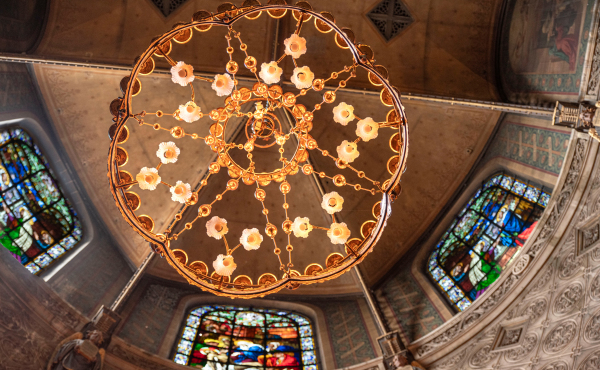
The American Cathedral in Paris has served an international community in Paris for more than 160 years. Founded in 1859, it was the first American Episcopal church established outside the United States. Today, the Cathedral describes itself as both English speaking and French speaking, with members from many countries, including people who are deeply rooted in Paris and others who are there for a short time.
Supporting that community and its ministries is part of the role of the American Cathedral in Paris Foundation, a U.S.-based 501(c)(3) affiliate established in 1984. The Foundation helps fund the Cathedral’s operating budget, buildings, and Mission and Outreach program. During the Covid pandemic, the Cathedral launched the Sandwich Ministry, providing daily meals to homeless neighbors in Paris. More recently, the Step Up campaign has donated new sneakers and socks to unaccompanied refugee youth in the city.
As the Investment Committee looked at the role the endowment played in supporting the Cathedral’s work, they began exploring whether the investment portfolio could more deeply reflect its mission.
Starting with ESG
The first step was learning. The committee spent time exploring what responsible investing could look like in practice and whether ESG-integrated funds were a good fit for the endowment. Educational forums helped members of the congregation better understand the role of the endowment, the meaning of fiduciary duty, and the basic concepts behind sustainable investing.
From there, the committee reviewed academic research, evaluated available fund options, and worked through governance requirements at both the Foundation and Vestry levels. They also paid close attention to a practical concern familiar to many churches: how to make meaningful changes while still ensuring that the Cathedral's operational needs would be met.
Several priorities emerged as guideposts. “The Episcopal Church has long affirmed our responsibility to protect the environment, and that translated into a close examination of our exposure to fossil fuels and extractive industries. Human dignity and social justice were equally central. We looked at labor practices, access to healthcare, and the treatment of vulnerable communities across our holdings. Corporate governance, the question of whether the companies we own are run with integrity and accountability, became a lens through which we evaluated our managers.”
The committee came to a different understanding of responsible investing. “It was not a departure from our fiduciary duty. It was an expression of it,” they said. “Stewardship, in the Episcopal sense, has always meant more than preserving capital. It means deploying resources in ways that reflect our deepest commitments.”
As an ECF Endowment Management client, the Foundation began exploring ESG-integrated fund options available through its investment program and agreed to incorporate those options whenever possible. The first ESG fund conversions took place in 2020. Today, the Foundation's public market holdings are managed through ECF in an active/passive portfolio with ESG screens, in partnership with State Street Global Advisors. Just under 70% of the portfolio is now allocated to ESG funds.
For many churches, that might have been the end of the story. For the American Cathedral in Paris, it led to a new set of questions.
Asking the Next Question
Even after increasing its ESG investments, the committee found itself asking whether more was possible.
"While this approach served the institution well, the committee sought to highlight, measure, and present an opportunity to have a deeper integration of the Cathedral's mission of inclusivity, social justice, service, and global outreach into the investment portfolio," they said.
That led to a new question: could a portion of the endowment be invested more directly in places and communities where it might do measurable good, while still supporting the Foundation's long-term financial goals?
That question marked the move from ESG investing to impact investing. ESG investing evaluates companies through environmental, social, and governance criteria. Impact investing goes a step further, intentionally directing capital toward projects and enterprises designed to create measurable positive social and environmental outcomes.
Diving into Impact Investing
The committee then turned its attention to a new question: what would it look like to invest up to 10 percent of the endowment in impact-oriented strategies?
The idea was simple but ambitious and required serious work. The committee explored opportunities in private credit, private equity, and microfinance. The committee spent months researching managers, engaging with leadership teams, reviewing historical fund performance and distributions, evaluating fee structures and risk controls, etc. Independent advisors with investment and legal expertise helped support the process.
Impact was examined with the same care as assessing financial return. They focused on evidence of additionality, theory of change, and outcomes with objective metrics. The committee ran financial scenario models showing how each strategy would contribute to the endowment’s annual cash flow via capital gains or income under conservative, base and optimistic outcomes.
They also reviewed how managers measured impact, operational risks, and governance practices. Potential investments were also mapped against several United Nations Sustainable Development Goals that aligned best with the Episcopal Church’s values.
The first investment was made in December 2025, with additional allocations occurring throughout 2026 as investment windows open. Over time, the combined allocation to ESG and impact investing is expected to approach 80%.
The managers and their funds selected have the following general characteristics:
- Microfinance across global emerging markets
- Private equity (VC), primarily in Africa
- Private credit, primarily in Southeast Asia
- Flexible credit, primarily in Latin America
What They Learned
As of spring 2026, the Foundation is in the deployment stage. One of the clearest lessons so far has been the importance of reporting. The committee has already built a custom reporting template to track both liquid and illiquid investments together, a step they would encourage other churches to consider at the beginning of the process.
This matters because once a portfolio includes illiquid alternative investments, it becomes more important to maintain one clear, unified picture of the whole endowment. Each manager typically provides a year-end valuation, and those figures need to be reconciled alongside traditional holdings. That can be done in a spreadsheet, a Word document, or through third-party software. However it is handled, the key is to plan for it from the beginning rather than treating it as an afterthought.
The committee does not identify anything they would do differently. But they are clear on one point: setting up comprehensive reporting from the outset makes the rest of the process much easier.
What Other Churches Can Learn from American Cathedral in Paris
The committee is clear that impact investing was not the first step. It came after years of learning, conversation, research, governance work, and ESG implementation. Their advice, "We would encourage churches to explore the notion of aligning their 'money with the mission' and start educating the Vestry and congregation about responsible investing. We found that some negative bias exists in the media towards responsible and sustainable investments and this needs to be addressed within the congregation and Vestry."
For churches considering private markets, there is also an important practical reality: this path may not be available to every institution. Certain private investment opportunities require organizations to meet minimum asset thresholds. As a general rule, organizations with less than $5 million in assets are often limited to public market investments. Those with more than $5 million may qualify for some private market opportunities, while broader access to institutional private investments may require significantly larger asset levels. Governance capacity, investment expertise, and organizational readiness also matter.
Susan McDowell, Managing Director, Endowment Management, reflected, “What stands out in the American Cathedral in Paris Foundation’s experience is the care they took in connecting their investment strategy to the Cathedral’s mission. They approached the process thoughtfully and deliberately, with a clear commitment to making sure their investments reflected the Cathedral’s mission and ministry.”
Different Churches, Different Answers
Like Grace Episcopal Church in Chattanooga and Christ Church in Oberlin, the American Cathedral in Paris Foundation began with the same question: how can the endowment better support the mission of the church? The solution was different for each church.
Grace moved to a fully ESG portfolio. Christ Church chose a blended approach that fit its risk tolerance and priorities. The American Cathedral in Paris Foundation built on its ESG foundation and then extended that work into private markets impact investing across four regions of the world.
Different churches. Different answers. But each began in the same place: asking thoughtful questions about what the endowment is for and what it says about the community that sustains it.
For the American Cathedral in Paris, that process started with a question they had never formally asked before. Where it leads is still unfolding.
_____________________________________________________________________________
Is your church interested in exploring responsible investing?
Learn more about the responsible investing options available through Episcopal Church Foundation's Endowment Management by contacting ECF's Endowment Management team at [email protected].
For those interested in learning more specifically about the American Cathedral in Paris Foundation's impact investing process and experience, contact [email protected].
-

Related Post
Five Questions to Guide Your Endowment Planning Susan McDowell, Managing Director, Endowment Management, poses five guiding questions for your endow… -

Related Post
Before the Gift Arrives: Preparing Your Church for an Endowment Gift Whether your church is receiving its first endowment gift or has had an endowment for years, having … -

Related Post
Are You Ready for the New Year? Are you ready for January’s annual meeting? A quick year-end pause during Advent can help leadersh…
 RSS Feed

