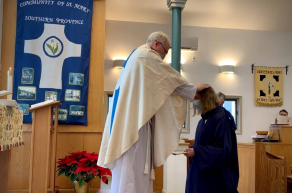
What if your calling isn’t something you chase, but something that’s been subtly seeking you all along?
When I reached out to Sister Hannah, an Episcopal nun with the Sisters of St. Mary in Sewanee, Tennessee, she described her spiritual vocation this way: “Instead of a moment, it was more like a very slow and gradual awareness of my call.”
Her words invite us to lean in and trust in the slow work of God.
Continue reading...
I Worried
I worried a lot. Will the garden grow, will the rivers
flow in the right direction, will the earth turn
as it was taught, and if not how shall
I correct it?
Was I right, was I wrong, will I be forgiven,
can I do better?
Will I ever be able to sing, even the sparrows
can do it and I am, well,
hopeless.
Is my eyesight fading or am I just imagining it,
am I going to get rheumatism,
lockjaw, dementia?
Finally, I saw that worrying had come to nothing.
And gave it up. And took my old body
and went out into the morning,
and sang.
Poem by Mary Oliver, Dream Works in1986.
Continue reading...
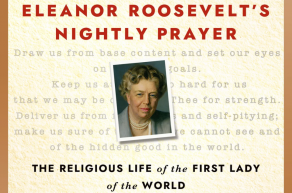
In his book Eleanor Roosevelt’s Nightly Prayer, Donn Mitchell explores the way this fierce advocate for justice and equality among human beings, both at home and abroad, was formed by her life lived in the liturgy and communities of The Episcopal Church. From childhood to wife of a president to leading participant in the United Nations, Eleanor Roosevelt was devout in her attendance in Episcopal Church liturgy and life.
Continue reading...
As Episcopalians, we pray for the poor.
The Prayers of the People in our Eucharistic liturgy include prayers for the poor, often along with the sick, the oppressed, prisoners, the unemployed and the destitute. And in the Daily Office we pray:
“Let not the needy, O Lord, be forgotten.
Nor the hope of the poor be taken away.”
Continue reading...
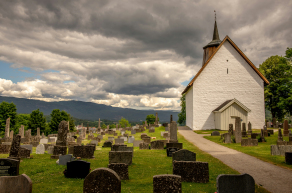
When something doesn’t work out, what do you do? And how long does it take to try something else? How many times have you heard: ‘we tried that once before’? Ironically, it’s closely related to ‘…but we’ve always done it this way.’
About seven years ago, a beloved, visionary member of St. George’s Episcopal Church in Valley Lee, Maryland died – much too early, and after she bravely fought an aggressive cancer. She was a friend to many, in part because she straddled so many worlds. She was a resident of Washington, DC and St. Mary’s County, Maryland; down here in St. Mary’s, she spent weekends and summers. Her funeral at the National Cathedral and burial in St. George’s churchyard were well-attended. But I walked away feeling such a gap, moving forward.
Continue reading...
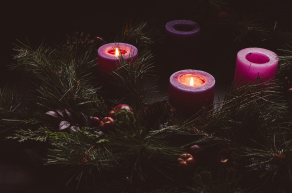
The Episcopal Church Foundation (ECF) invites you to take the time this year to celebrate Advent, a season to pause and reflect on the hopeful miracle that is to come. To help you in your preparations, we’ve gathered sixteen resources below. We pray that your Advent 2025 is filled with peace, health and hopeful anticipation.
Continue reading...
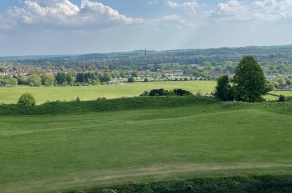
There’s an enormous hill several miles outside of the city center in Salisbury, UK. If you were to climb the tower of Salisbury Cathedral you’d see it in the distance. It’s such a permanent fixture in the landscape that local roads wind around it, and you run into it wherever you try to navigate. The local topography is already hilly in that part of western England, but this is clearly human-made: it ascends with well-plotted symmetry, rise by rise. Scholars suggest the earliest version of this ancient hill-fort was started around 400 BCE as a strategic fortress at such a key crossroad.
Continue reading...
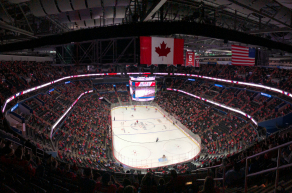
Reflections from a Sabbatical Road Trip
Earlier this month, I took a short sabbatical road trip with my six-year-old son— a journey that took us from our home in Michigan through Ontario and into Quebec, with stops in Toronto, Ottawa, and Montreal. Along the way, we immersed ourselves in one of our favorite pastimes: hockey. We caught NHL games in all three cities, visited the Hockey Hall of Fame, and sang along to Stompin’ Tom Connor’s The Hockey Song more times than I can count.
Continue reading...
A decade ago, Sam Wells and Abigail Kocher offered a book, Shaping the Prayers of the People: The Art of Intercession. It inspires clergy and laypersons to craft prayers for public worship on Sunday mornings. It encourages an integration of the Scripture readings of the day, the cares and concerns of the world and of the people gathered. It favors deep intentionality over spontaneous prayers. It recommends that the clergy and the layperson who will be leading the prayers in the Sunday ahead meet during the week to prayerfully consider that integration and focus.
Continue reading...
This story begins at a time of genocide, when an evil ruler set out to wipe a race of people off the face of the earth. A baby boy was born to them, and though his mother tried to hide him away, a growing baby can’t just keep quiet. In desperation, she floated her infant son in a basket on the big river. The ruler’s daughter found the baby and took him home to raise him in the palace.
Moses grew up in comfort and privilege, insulated from the suffering of the people outside his cocoon. Then one day, as a young man, he began to explore the city outside the palace walls. Men who looked a lot like him were working at hard, physical tasks. Women surrounded by skinny, wide-eyed kids peered at him out of their half-open doors. Soldiers roamed the streets, lording it over the men and leering at the women.
Continue reading...
ECF invites you to take the time to celebrate Advent, a season to pause and reflect on the hopeful miracle that is to come. To help you in your preparations, we’ve gathered thirteen resources below. We pray that your Advent is filled with peace, health and hopeful anticipation.
1. Find Advent and Christmas resources from The Episcopal Church here, including an updated Journeying the Way of Love Advent calendar and curriculum, bulletin inserts, and Advent and Christmas Digital Invitation Kits. Most of their resources are also available in Spanish and French.
Continue reading...
My home church recently held its annual Steak Fry. I remember hearing about this event as a child, but it was never an option for us. It wasn’t really for my parents, either. Back then, it was an event for older, more mature (read: no small children at home) kind of adults.
That was the culture of my home church, my home neighborhood’s Old First Church. They excelled at all things social. There was the fall Harvest Home Dinner which, in previous generations, was a multiple day event. A bazaar in the fall featured an elegant luncheon in the room children were never allowed. My mother, in fact, is still a member of the ‘circle’ she joined in the 1970s. Evidently, there were lots of women’s circles – and they all had strange-sounding names (there was even a circle called “octagon”). One time, I asked her what they were, these ‘circles’. “Our group of women,” she replied. I tried to dig a bit more into what, precisely, their purpose and mission and objective were. Those weren’t exactly fruitful questions.
Continue reading...
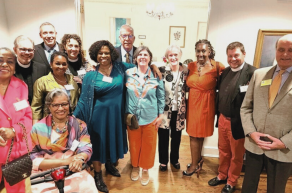
L to R: Jo Ann Roberts, Toni Daniels, The Rev. Tim Murray, Devorah Crable, The Rev. Cynthia Rigali-Lund, Tom Lund, Yvonne Lembo, Donald V. Romanik, Ann Ryan, Margaret Romanik, Cecelia Mowatt, The Rev. Matthew Hanisian and Sr. Warden, Gary Martin in Chicago, IL.
I announced my retirement as president of the Episcopal Church Foundation (ECF) in November 2023, effective at the end of 2024. Yvonne Lembo, our Director of Development, and I considered how to commemorate this transition year, especially since 2024 also marked the 75th Anniversary of ECF. We decided on a five-city farewell tour nicknamed “Faithfully Yours.” We selected venues in Austin, Los Angeles, Atlanta, Washington D.C. and Chicago and decided that the main purpose of these events would be to thank donors, clients, constituents, and friends for their loyal support of both ECF and me over the last 19 years.
Continue reading...

“The way we’re trying to change the world is not going to work,” says Deborah Frieze, “and it’s never going to work.” That’s how she begins her 2015 TEDTalk, “How I became a localist”.
“You can’t fundamentally change big systems,” Frieze claims. “You can’t undo, fix, reverse engineer, redirect or reassign these systems. That’s because they’re not machines: they’re living systems.”
Continue reading...

Church of the Ascension in Lexington Park, Maryland owned a house next door to the church. It was never the rectory. It was given to the church in 2000. For many years, Ascension rented it to a local transitional living shelter. The congregation, as landlords, managed and maintained the property as well as they could – but it wasn’t a well-built home in the first place, having been thrown up fairly inexpensively along with all the other homes in that post-WW2 neighborhood in the late 1940s. Having a constant turnover of residents as well as a shelter serving as tenant also posed ongoing challenges, but the church was serving the needs of the neighborhood. Sure, there were annual property tax payments and maintenance costs but, still, the $1,700 rent check each month was nice for the congregation’s cash flow.
Continue reading...
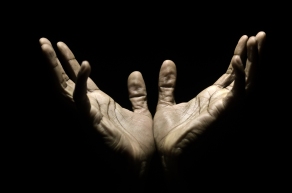
On All Things Considered, a program of National Public Radio, the story was told of two couples in Brooklyn, New York, maintaining a practice begun in the days of COVID isolation. Every day they lean out a window or stand at their doorstep and ring bells, shake a tambourine and bang wooden spoons together in support of health care workers. Because, they maintain, health care providers still need our support.
Now the odds are there aren’t many healthcare workers who know about this ongoing sign of support for them, at least until NPR ran the story. But the support was there nonetheless. And one neighbor observed, “it’s kinda cool” that his neighbors are remembering those who can so easily be forgotten, and he likes being reminded of the importance of health care workers each night.
Continue reading...
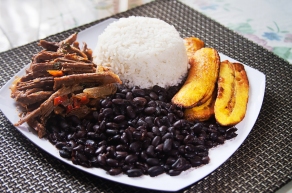
Somos una familia de 6 personas donde hay tres niñas, un niño, mamá y papá. Somos venezolanos, orgullosos de nuestra nacionalidad. Somos de tierras llaneras. Esas tierras consisten mayormente de ganadería dónde el cultivo es una de las mayores riquezas que hay entre Venezuela y Colombia. Son numerosas las fincas con ganado y sembradío. Amamos nuestro país y nuestras raíces.
Continue reading...
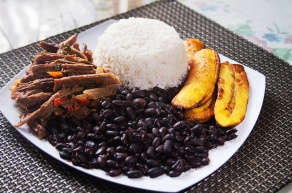
We are a family of six with three girls, a boy, a mom and a dad. We are Venezuelans, proud of our nationality. We are from the plains. These lands consist mainly of livestock where cultivation is one of the greatest assets between Venezuela and Colombia. There are numerous farms with livestock and crops. We love our country and our roots.
Continue reading...
In the Summer of 1995, I ordered two books that changed how I experience ministry in the parishes, vestries and groups I have worked with. The two books were: Listening Hearts by Suzanne Farnham et al and Rediscovering Our Spiritual Gifts by Charles V. Bryant. I had been well trained in Organizational Development for churches but all too often the presence and power of the Holy Spirit was at best an afterthought, but never a starting place.
I have learned the better part of wisdom is to start with the Holy Spirit, home to both spiritual giftedness and discernment. I use these two practices together to understand spiritual DNA, in the same way people are born with blue or brown eyes, people are born with spiritual gifts such as healing or leadership.
Continue reading...
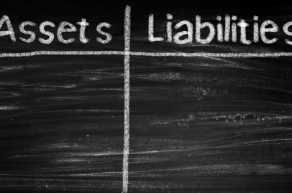
Assets and liabilities, that’s Accounting 101. Assets generate income or initiative or power, whereas liabilities are those things that cost money and cost energy, focus, attention. Assets and liabilities.
The church’s greatest assets, of course, are the Holy Spirit and God’s people. To have a truly divine inspiration and calling, such that our vision will always exceed our human capacity – making us rely on God’s power, not our own – well, that’s an asset. That’s our primary asset. Clergy and lay leaders are our second greatest asset. If we’re prioritizing assets, The Episcopal Church should not only imagine but hasten to implement a future in which these two assets are lifted up as our greatest strengths. Anything else – everything else, in fact – should be shaped around these.
Continue reading...
 RSS Feed