September 25, 2024
Give Your Community Their Church Back

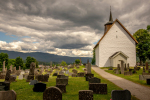
Less than 200 yards down the lane from St. Andrew’s Church in Bemerton, just outside Salisbury UK – best known to Anglicans as George Herbert’s church – is the Church of the St. John the Evangelist. Compared to humble, rustic St. Andrew’s, St. John’s is massive. From St. John’s churchyard, one can see the roof line of St. Andrew’s. Standing in that very spot it appeared to me, at least, that St. Andrew’s could fit entirely within the chancel, alone, of St. John’s! Whereas St. Andrew’s is a small, intimate 13th century building, easily filled with 30-35 people, St. John’s is a much larger edifice, built in the 19th century. According to the Parish website: “The foundation stone of the church was laid on the 9th April 1859 by Elizabeth, wife of Sidney, 1st Lord Herbert of Lea.” Did you catch the family name? It was something of a Victorian vanity project, by which I mean no disrespect: so-called ‘vanity projects’ at one point did actually involve libraries and schools and churches. Shortly after its consecration, St. John’s became the parish church of Bemerton Parish, which included St. Andrew’s.
It’s a stunningly beautiful building, inside and out: a remarkable reredos; carvings on the pillars; a brass lectern given by the Prime Minister; and a stone and marble baptismal font, part of which was the old font taken from St. Andrew’s. According to the website, “On the west wall is a brass plaque, with an inscription in Latin and English, recording to the dedication of the church in memory of George Herbert:
To God most High
In memory of His Servant
George Herbert A.M.
Of the ancient race of the Earls of Pembroke
A renowned poet – a chaste priest – a good citizen
Formerly Public Orator in the University of Cambridge
and Rector of the Parish
This Church as a monument to so excellent a man
Was erected by subscription
A.D. 1861
For those who know George Herbert’s story and how he wound up as rector of a country parish, it should sound a bit strange that such a massive, ornate, gilded building was erected in his memory. He did love the arts and music and finer things, that much is true, but Herbert’s time in Salisbury was a movement away from those trappings of court and prestige. But the Victorian era was also what it was, and in those years the poet of Bemerton was coming into greater literary and cultural appreciation. Sometimes our legacies are unknown even to us, so we do our best in the moment and place in which God has planted us.
Which is what explains the rest of the story of St. John’s Church. Sure, things were grand and glorious in 19th century Britain, but trends in church involvement and participation began to trend noticeably downward by the middle half of the following century. Still, the state church had schools to run and communities to nourish, and the identity of Bemerton Parish itself shifted – away from Wilton, with which it was historically connected, and toward the newly developed post-WW2 suburban developments outside the train tracks that run into Salisbury. St. John’s identity as a church was also on shaky ground, having only been established for less than a century, and so St. Andrew’s and a newer, suburban church were kept open as part of a Church of England parish scheme, but St. John’s itself was closed.
But don’t let that sound like the end of St. John’s story, for it’s not at all. You see, St. John’s sits directly across the little lane from a Church of England primary school, and is used frequently as an assembly space by the school itself. Also, St. John’s altar and chancel are still consecrated spaces, and it’s used quite frequently for weddings and baptisms, even funerals and burials in the churchyard. One day, several years ago, when I was taking a stroll through Bemerton, St. John’s doors were open – which is how I was able to get in and walk around – where I met a family who was coming in with streamers and balloons, setting up for a 10-year-old’s birthday party, soon to begin. Now known as St. John’s Place, there’s a host of community-run, community-driven events and gatherings – from chair yoga to exercise classes for the 55+ crowd, to weddings and wedding receptions, to movie nights and concerts, to speaker series and lectures, to a beautiful rental space for parties and family reunions. It’s a safe bet to say that St. John’s Place is used by the community for the community more frequently than St. John’s Church ever was!
Maybe this is all a bit over-stated. I’ll be honest: St. John’s Church becoming St. John’s Place is about the most transformative example of truly adaptive change I’ve ever seen, and it’s a very big deal. I’m sure it did not come about easily and I know there were (maybe ‘are’ still) hurt feelings and a sense of loss and pain. This is not a small thing. Creating St. John’s Place should not be put out there as a blog post about what anyone in church leadership should attempt to do or be or become. In Bemerton, it was clearly an organic development and I’m sure it was a long, loooong process.
That said, however, which one of our churches and, specifically, church buildings was not, in fact, built and planted where it is apart from a community surrounding it? Which one of our church buildings was not community-run, community-driven?
Little St. George’s in Valley Lee, MD – one of the churches of Resurrection Parish, where I serve as rector – is an 18th century building, built atop a 1638 foundation stone, sited on an ancient main road (not the current highway that runs nearby) which directly connects the two primary plantations nearby in Maryland’s earliest decades. In fact, St. George’s is equidistant – literally halfway between the two manor homes. It was the landowners’ little chapel. That’s why it was built.
Church of the Ascension in Lexington Park, MD, Resurrection Parish’s other campus, is a fairly new building – the cornerstone says 1954 – but it was built on the highest hill on Great Mills Road, just outside the newly-created Patuxent River Naval Air Station (created by the U.S. Department of Defense in 1943) because a newly-planned subdivision with 250 homes was already under construction as of 1947. I’ve seen the pictures in the late-1940s and 50s: happy little children riding their bicycles in and around the neighborhood called Patuxent Homes, pulling their sleds up the snowy hill at Ascension and sliding down. Those pictures of a united, post-WW2 (mostly white and suburban) neighborhood also coincide with the same pictures I see of gatherings inside Ascension – in what some have called the church’s ‘glory days’.
But Lexington Park has changed dramatically now, so much so that it’s our County’s most ethnically - and racially - diverse community and most population-dense. It’s also home to our County’s working poor. More than 40% of the 12,000 residents of downtown Lexington Park – the area immediately surrounding Church of the Ascension – live below the federal poverty line. While the median household income in St. Mary’s County, MD is more than $113k, the median household income for those residents who live in walking distance to Church of the Ascension is around $57,000.
Church of the Ascension, like St. John’s in Bemerton, would’ve also been shuttered, closed; actually, in Ascension’s case, it likely would’ve been sold. It’s not an historic building, nor does it have a churchyard (Anglican for ‘cemetery’). The congregation recognized as much back in 2015, when they looked at their numbers – financial and people – and gave themselves three more years, maybe five if they could pinch pennies. Thus the ministry sharing and yoking and, eventual, merger between St. George’s and Ascension. Turns out, a lot of Episcopalians did not want to, in fact could not live with any Jesus-shaped integrity in a community and allow the church with the largest food pantry, most impactful and coordinated outreach ministries, and affordable counseling center to become shuttered.
At Ascension and at St. George’s, we’ve been actively working on giving our churches back to our communities. A concert series at St. George’s, started to intentionally bridge connections between our neighbors and congregation through cultivating the arts and bringing world-class recording artists to St. Mary’s County – that’s one small example. Creating an intentional partnership among 10 non-profit, social justice organizations, all of whom have at the heart of their mission the transformation of and by the residents of downtown Lexington Park – that’s part of Ascension’s commitment. We’re not just renting space. We’re sharing everything from our very heart with a desire to make our building the community’s building, the neighborhood’s building.
Give your community and your neighbors their church back. If you want your church to grow and prosper and thrive, make your neighborhood grow and prosper and thrive. It’s literally the only way we’ve ever had thriving congregations in The Episcopal Church, and I’ve seen the pictures to boot! You have, too. When the neighborhood around the church was abuzz with clubs and activities and organizations and local pride, so too was the church. When the neighborhood began to grow more tired, less connected; when local businesses began to close-up or move elsewhere; when there was a sense in the wider community that our glory days were behind us – so too did the church begin to act and talk and feel that way.
Church of the Ascension is making itself a great church by making its neighborhood a truly great neighborhood. St. George’s is making itself a great church by making its neighborhoods truly great. Try it, too: give your community and your neighbors their church back.
-
Related Post
Failing Upwards When something doesn’t work out, what do you do? And how long does it take to try something else?… -

Related Tool
Why is Creation Care So Important? The Rev. Bradley Mattson explores Jesus' teachings about fulfilling God's law, emphasizing that crea… -
Related Tool
Episcopal Migration Caucus The Episcopal Migration Caucus is a group of Episcopalians, lay and ordained, advocating for strong …
 RSS Feed
-

Related Post
Walking Through Fear to Joy -

Related Tool
Building Your Asset Map: Building Authentic Relationships -

Related Tool
Approaching Change in a Congregation