March 28, 2025
Small, Strong Congregations
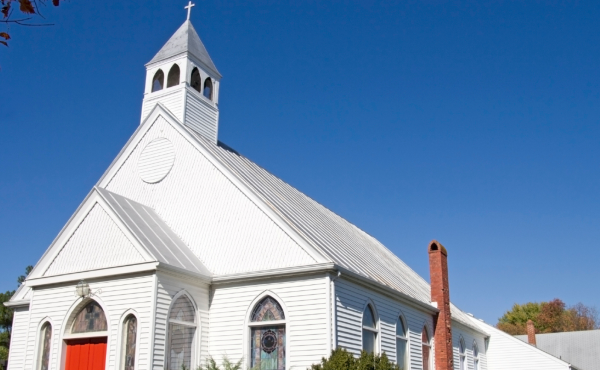
Many years ago, a couple I knew from the church where I served as curate came to visit me at my new church. My previous church was large, the largest in terms of Average Sunday Attendance (ASA) in that urban deanery, and this church – the congregation I still serve as rector – was small, quaint, historic.
At lunch that day, the couple asked me how it was going. Even though it was early in my ministry, and I was dealing with all the issues that go along with moving to a new state and and learning a new community, I shared that I got the sense that I would likely be just as busy as I was at that larger church. “But it’s hard to imagine,” I shared, “given that this church is less than a third in terms of membership of that previous church.” Maybe it was because, previously, I was one of three clergypersons on staff? Maybe because I came from a system in which there was greater staff support overall – a full-time parish administrator and part-time bookkeeper, not to mention a sexton and a youth ministry director?
The wife of the couple, a trained therapist, shared instead: “Perhaps in going from there to here, you’ve exchanged quantity for intimacy?”
Her comment has never left me, and I’ve long suspected that her insight was spot-on. Not only do those so-called ‘small’ churches in have an important place, but they are vital to the long-term strategy of the whole church.
I could take a turn, here, and go on about how The Episcopal Church (TEC) is shrinking, or re-sizing, if that sounds like a better term. How our ASA, even pre-Covid, was trending downward in stark ways. Or, looking at meta-trends from parochial reports, churches with ASA of less than 50 are growing but churches with ASA of 300+ are becoming less and less. I could reference those sociologists who suggest that TEC and other mainline Christian churches will run out of people at some fixed date in the near horizon, even though we evidently won’t run out of money. I might like to also point out my dislike for the term “small” when we use it to talk about congregations, as that term has a largely unhelpful value connotation and, in fact, ‘small’ is entirely relative in terms of wider trends in organized, institutional Christianity in the west.
But I’ll leave that potential other post (which will show up in your newsfeed whether I write it or not) and return, instead, to the heart – and hope – of the matter.
“In the century before us,” Kennon Callahan wrote in his little book, Small, Strong Congregations (2000), “God gives us four futures for congregations:
1. Small, strong congregations
2. Middle-sized congregations
3. Large, regional congregations
4. Mega-congregations
Each of these is a distinctive way of thinking, planning and acting as a church. The result is a congregation of a certain size.”
A few paragraphs later, Callahan goes on: “Small, strong is tough. Large, regional is tough. Both of them are an easier tough than the middle. The toughest future for a congregation is the middle. The middle is tough-tough. The middle gets beaten both ways. It is too large to deliver the intimacy of small, strong. It is not large enough to deliver the resources, programming, and staffing of large, regional. It is tougher than being a church caught on a plateau; it is the church caught in the middle. Moreover, it usually has fewer staff, more buildings, and a larger debt than is helpful to do the middle successfully.”
It's ultimately a question of health and wellness, not size and capacity. “Small, strong congregations and large, regional congregations do what they do well – with extraordinary competency,” Callahan continues. “They do not deliver mediocre, halfway behavior patterns. They focus on delivering the qualities that are distinctive to small, strong and large, regional churches, and they deliver them in so strong a fashion that both are healthy, constructive congregations.”
There’s a lot that is difficult or, as Callahan says, ‘tough’ in small congregations. There’s not enough people and burnout is real. There’s not enough money and limitations are frustrating. Oftentimes there are too many buildings, so deferred maintenance issues can suck the energy – and financial resources – out of the equation. Add to that that there’s always, in every region, that new, large, big-box mega-church – quite literally focusing on rising generations and young families (with relative success, I might add) – all of which only increases the struggle.
As a practitioner of collaborative, regional ministry development among, now, three partner congregations (two parishes, three churches) in one region of one diocese, I and those I get to serve with have found tactical solutions and some proven strategies to deal effectively with these complications (…well, all but how to take on the big-box church). Maybe that should be another blog post, although if you scan what I’ve written for ECF over the years there’s plenty of information and tools and ideas already recorded. I have a burning passion for ensuring that every local Episcopal congregation finds a way to thrive where it’s planted, and step one often looks like sharing a lot of the burdensome load of congregational management in a concerted way via formal partnerships.
But none of those tactical solutions supplants the heart work – and gospel hope – of parish ministry, which is about celebrating and honoring the deep ways in which small congregations are, at their very best, strong congregations. Intimacy and connection are powerful gifts, and doing life together is one of the hallmarks of these types of churches. My former parishioner was right: in small, strong congregations we, in leadership, get to focus on intimacy over quantity. That’s a gift for clergy and lay leaders, no less a gift for the Body of Christ.
I find it very encouraging to think of a clearer way forward into this new reality, perhaps best summarized in these last words I’ll share from Callahan’s timeless little book: “We have made the mistake of being preoccupied with the patterns of behavior in small congregations that contribute to their being weak or dying. We have been much engrossed with the sources of illness and weakness in small congregations. Then, we assume that these patterns happen only in small congregations. As a matter of fact, I find that these patterns happen in all four futures of being a church.”
For those who find yourself as a lay leader or clergy leader in a so-called ‘small’ church, how will you fast this Lent from being preoccupied with the patterns of behavior that contribute to weakness or dying? How, instead, will you feast on intimacy, connection and those relationships that are filled with God’s new life? Even more so, how will you, as a leader in your church, move in the direction of those areas in which God’s new life is actively springing forth?
-

Related Post
The Art of Organizing, Part Two: Building Capacity for Sacred Resistance In The Art of Organizing, written during the early stages of the emerging COVID pandemic, Rev. Dr. G… -

Related Tool
Faith-Based Community Organizing: Book Study Groups This list includes resources to help your small group engage in meaningful conversations about congr… -

Related Post
What's Next in Clergy Calls? Greg Syler discusses the current state of clergy calls, their recent history, and asks for next step…
 RSS Feed
-

Related Post
Who Will Lead Your Endowment Committee Next? -

Related Tool
Building Your Asset Map: Building Authentic Relationships -

Related Tool
Approaching Change in a Congregation