September 12, 2025
The Art of Organizing, Part Two: Building Capacity for Sacred Resistance
This post comes as a "Part Two" to the Rev. Dr. Garcia's Vestry Paper article, The Art of Organizing, published in March 2020.
In The Art of Organizing, written during the early stages of the emerging COVID pandemic, I focused on the relational aspects of organizing, often rooted in one-on-one conversations, and shared an example of an ecumenical, community-based campaign focused on housing justice.
Five years later, we find ourselves in a different set of crises, one of rising authoritarianism at the highest levels of political office and targeted attacks on many of the most vulnerable members of our community. As the Rev. Dr. Martin Luther King Jr. mentioned generations ago—the “triple-prong sickness that has been lurking within our body politic from its very beginning…the sickness of racism, excessive materialism and militarism”—remain at an all-time high, and have metastasized to include many intersections of exploitation, injustice, and suffering to both people and planet. He called for a reordering of society, a revolution of values in fact, away from the “thing-oriented society to a person-oriented society.”
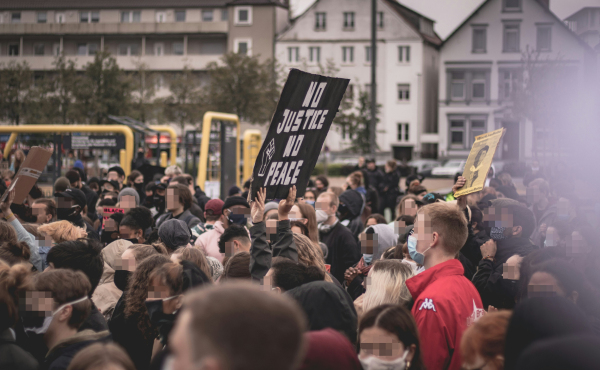
In this current political moment, I offer a part two, focusing on how many communities are organizing and responding to stand in solidarity with our immigrant neighbors in particular, based on my experiences with facilitating such work through a ministry called Sacred Resistance in the Diocese of Los Angeles. People from all walks of life, including many Episcopalians, are showing up in growing numbers to do their part.
What Grounds Us: Faith-Rooted Organizing and Nonviolent (Sacred) Resistance
First, from its inception, the work of Sacred Resistance has been intentionally grounded in what Alexia Salvatierra and Peter Heltzel call a faith-rooted organizing perspective, which emphasizes “bringing people together to create systemic change in our communities and world in a way that is completely shaped and guided by our faith.”[1] When it comes to our Christian faith in the Episcopal tradition, Sacred Resistance looks primarily to the Baptismal Covenant, wherein we promise, among other things, to “persevere in resisting evil;” to “seek and serve Christ in all persons, loving [our] neighbor[s] as [ourselves]; to “strive for justice and peace among all people;” and to “respect the dignity of every human being.” These two things combined—an approach rooted in our faith, and a faith that calls us to confront evil and strive for justice, leads us to the idea of sacred resistance—that to work for the beloved community in the here and now is how we honor our commitment to love God and neighbor, challenging the many isms that relate to race, class, gender, sexuality, nationality, immigration status, disability, and other identity markers. This is our work to do as the Episcopal Branch of the Jesus Movement, in community with other Christians, with people from other faith traditions, and all people of good will and conscience. This work is necessarily guided by a deep commitment, in the tradition of many faith-rooted justice movements and broader social movements before us—in the philosophy of nonviolence and the practice of nonviolent direct action. For instance, Sacred Resistance often provides trainings where we review and reflect on the Kingian principles and steps of nonviolent social change, among other approaches, in the context of current realities that we are facing. The teachings of Rev. James Lawson, who worked closely with Dr. King and worked for decades in Los Angeles, have also been central to our work. Most recently, we have partnered with many groups to engage in practices of various scenarios from responding to ICE raids to de-escalation techniques in tense moments at a protest.
A Framework for Being the Jesus Movement More Effectively: Social Movement Leadership
While the above speaks to the spiritual, theological, and philosophical grounding that guides our practices, it is also important to develop an organizing approach that is effective and sustainable for the long-haul. For this, I draw upon the work of organizing scholars and practitioners, Marshall Ganz and Elizabeth McKenna, who have identified five practices of social movement leadership: (1) relationship building, (2) narrative, (3) strategy, (4) structure, and (5) action. It is my contention that as the church—whether at the parish, diocesan, or larger institutional levels—while we often get the faith grounding part done right, developing strategic plans around organizing and movement building is a growing edge for us. Yet, I’ve seen substantial strategic plans developed for building campaigns and stewardship. So, it is possible to translate/transfer these skills and leverage them for the common good of sacred resistance. Here I offer a short summary and application of Ganz and McKenna’s five social movement leadership practices toward this end.
Relationship Building
While I touched on relationship building in The Art of Organizing (part one), we can never talk about this too much. Ganz and McKenna note that:
"A foundational social movement leadership practice is recruiting individual participants by building relationships with them. This goes beyond mobilizing individuals to join through transactions of resources and interest by requiring commitment to future engagement, most often rooted in the experience of shared values. Collective capacity, in turn, can be built from the trust, learning, and solidarity growing out of the formation of affiliative horizontal relationships that enable the development of shared interests, the construction of shared resources, and the commitment to use them."
What Ganz and McKenna are trying to get across is that social movement-oriented relationships are built when people feel connected to other people in a shared project or goal that inspires them and requires something of them. Again, as the church we’re pretty good at identifying recruiting individuals to internal church commitments like serving on vestries and other committees, and sometimes even an outreach or social action committee. While such committees are a start, they can often remain insular and stagnant. A broader relational approach seeks to engage entire communities in a process of shared values, interests, and action. In Sacred Resistance, we seek to engage a representative cross-section of our diocesan community through these “affiliative horizontal relationships” in common cause together.
Narrative
Our stories—individual and collective, past, present, and future—matter. Ganz and McKenna describe the use of narrative in social movement leadership as “a way to access, express, and cultivate emotional resources embedded in shared values—resources that are necessary to confront challenges with courage, resilience, and agency.” Ganz has developed this idea further through his framework called public narrative, which incorporates three different stories into one: “the story of self, the story of us, and the story of now.” In this deceptively simple approach, we connect the important moments of our own lives and the people and concerns that we hold dear (story of self), with the shared experiences and values of a given community or group of people (story of us), and integrate these two into an urgent, strategic, and collective call to action (story of now). For instance, in my own life I can identify a moment in high school when I first became aware of the active criminalization and targeting of immigrant communities, something that I felt deeply as the son of Mexican immigrants; this combined with an understanding that there were many others in my neighborhood that were similarly impacted; then, I felt moved to join with fellow classmates and rally together against such injustices. In the work of Sacred Resistance, our diocesan community brought all of our stories of self and us together into a powerful collective story of now when we unanimously passed a resolution in December 2016 to become a Sanctuary Diocese. As I’ve noted elsewhere, a galvanizing moment occurred when we heard a testimony from one of our own beloved clergy at the time, the Rev. Nancy Frausto, who shared her own public narrative and precarious status as a DACA recipient. This moment guides us still, even as we grow and adapt to quickly changing circumstances as immigrant communities and anyone perceived to be “illegal” are now fully at risk of being questioned, detained, and possibly deported given the current administration’s aggressive tactics of profiling based on race, employment, and language, and the Supreme Court’s blessing of such an approach. Sadly, we had a story of us moment thrust upon us when over a dozen church members were unjustly detained and inhumanely treated during a major round of ICE raids on June 6 in downtown Los Angeles. This has only strengthened our resolve, and it’s been the power of public narrative that has kept us grounded in the stories that connect, sustain, and inspire us to ongoing action.
Strategy
As Ganz and McKenna note, while narrative deals with the emotional content and resources needed to take action, strategy deals with the cognitive aspects of the work. They define strategy as “the practice of turning the resources you have into the power you need to get what you want.” Strategy, they emphasize, is not something that we as leaders have, it is something that we do, repeatedly. It is ongoing, adaptive, and contextual work, keeping an eye on both the view from the “mountain” (macro, big picture) to the “valley” (micro, local, on the ground). Good strategizing is not done alone, but done best in a leadership team, in constant conversation with a base and with collaborative partners. Sacred Resistance from the beginning has sought to work in such a way by building a diverse lay and clergy leadership team representative of the diocese and in strategic collaboration with ecumenical, interfaith, immigrant rights, labor union, and community partners at the local, statewide, and national levels.
Structure
What we might think of as church polity, Ganz and McKenna think of as structure. Building on the notion of good strategy: a transparent, well-organized and participatory structure that enables how the work gets done is essential. They note that “well-designed, interdependent leadership teams are one way to avoid structurelessness on the one hand, and the fragility and narrowness of relying on a single person who holds all authority on the other.” Good structure allows for effective ways to make decisions, develop mutual accountability, share and deploy resources, and advance leadership development in support of the work. Given the scale of the Episcopal Diocese across Southern California, developing grassroots leadership teams in every region is a work in progress. However, because so many communities have felt the impact of ICE raids, there is active and renewed interest among laity and clergy to engage locally through various forms of action.
Action
Putting these elements all together, Ganz and McKenna note: “to transform individual resources into collective power, it is not enough to build relationships, tell stories, devise strategy, and enact structure. Resources like time, money, and commitment must first be mobilized to a common effort and then deployed through diverse tactics—including but not limited to mass mobilizations.” Deploying resources in various forms is what they call action. In our current political moment, there are countless opportunities for taking action. Oftentimes people may feel either apathetic on one end, thinking that their actions do not make a difference, or overwhelmed on the other end, wanting to get engaged but not knowing where to start. The work of faith-rooted social movement leadership helps pave the way for meaningful and connective engagement. Each month, Sacred Resistance gathers members of our community and provides outlets for action. On a regular basis, members of our network are connecting locally in their communities, joining local rapid response networks, adopting day labor corners or other locations where immigrant workers are most at risk of a raid, accompanying people to immigration check-ins or court hearings, providing pastoral care to impacted families and first responders of immigration raids, raising funds for legal defense and ongoing economic needs for impacted families, getting trained in nonviolent methods and engaging in public forms of witness, and preparing for visitations to detention centers. In addition, our leadership team is providing support and guidance to other individuals and groups across the state and country that are interested in developing their own forms of sacred resistance. Finally, bringing strategy and action together, we’re actively engaged in broader conversations about how we not only resist and disrupt unjust policies and practices but also construct alternatives for the future.
Returning to the Sacred
In our current moment, as people of faith, and as the Episcopal branch of the Jesus movement, we can play a much-needed role in upholding human dignity in all its forms in the face of dehumanization. In prophetic and sacramental acts, we help bring the sacred into the resistance. Through faith-rooted organizing engaged in social movement leadership, we follow in the spirit of Jesus of Nazareth, who opened the Isaiah scroll and proclaimed good news to the poor, freedom for prisoners, sight for the blind, and promised to free the oppressed. Through an expanded and more organized sacred resistance, we get just a little closer to building that beloved community and proclaiming the year of the Lord’s favor.
---
[1] Alexia Salvatierra and Peter Heltzel, Faith-Rooted Organizing: Mobilizing the Church in Service to the World (Downers Grove, Illinois: IVP Books, an imprint of InterVarsity Press, 2014), 9.
-

Related Tool
Building Your Asset Map: Building Authentic Relationships Congregations often forget that their most important mission field is int heir own backyard. This le… -

Related Tool
Approaching Change in a Congregation Every congregation and community of faith faces the need to change. This lesson workbook wil lintrod… -

Related Post
A Lenten Checklist The Rev. Kenneth Kroohs shares a checklist of tips and thoughts about outreach for Lent.
 RSS Feed

