February 5, 2026
Eleanor Roosevelt and Us
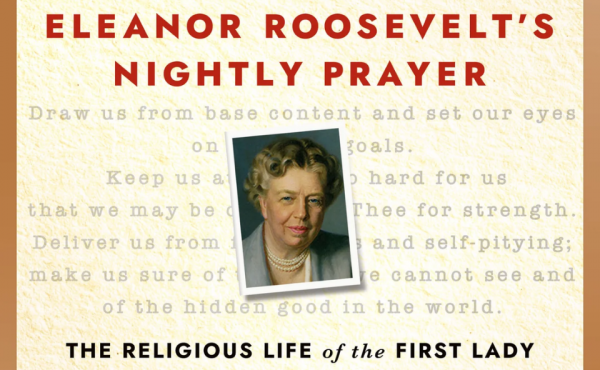
In his book Eleanor Roosevelt’s Nightly Prayer, Donn Mitchell explores the way this fierce advocate for justice and equality among human beings, both at home and abroad, was formed by her life lived in the liturgy and communities of The Episcopal Church. From childhood to wife of a president to leading participant in the United Nations, Eleanor Roosevelt was devout in her attendance in Episcopal Church liturgy and life.
To make the connection between her devotion to God as revealed in the church and her action in the world, Mitchell explores the writings and records of the parishes and dioceses of which she was a part, unpacking sermons, hymns sung, Bible studies shared, parish programs, and engagement with their wider communities, Bishop’s statements, and more.
What emerges is a God of grace and justice who cares for the poor and extends hospitality to all. What emerges too, is a woman who volunteered at Settlement Houses as a young adult, who worked for justice and equality for women and people of color throughout her life, who provided numerous scrambled egg suppers for house guests of every stripe and background (her scrambled egg recipe can even be found online), and who oversaw the creation of the Universal Declaration of Human Rights for the United Nations. She was kind, and she persevered.
Through this story of Eleanor Roosevelt’s formation, we are invited to pay renewed attention to our own formation Sunday by Sunday, season by season, liturgical year by liturgical year.
How are we being formed? Certainly by the Eucharist, central to our worship. Week after week, we gather as the Body of Christ, we receive the Body of Christ, and we become the Body of Christ, given for the world, more and more. More occasionally, we are formed by the Baptismal rite. Not so much our own baptism, which we may not remember, but by the Covenant that was written into our Book of Common Prayer, laying out not only our faith, but the way in which that faith is to be expressed in our daily living.
These two sacraments are formational enough, but there’s more! We are formed by the architecture of our worship space, by the furnishings and how they are arranged – the baptismal font, the altar, the pews or chairs, all give us a sense of who God is and who we are meant to be.
We sing together. Hymns become familiar and penetrate our psyches and our souls. We pray together. We hear the Collects each Sunday, repeated year by year, and may surprise ourselves when we realize that some of their words and phrases have become part of our own vocabulary. We are organized to engage with others who help us to know more fully the love of God for humankind and all of creation.
In all of this, we are formed as followers of Jesus, learning and experiencing the way of God and the way to God.
Here in the Diocese of North Carolina, we were formed by the recurrent call from our Bishop Michael Curry to “follow Jesus for real”. And when he was our Presiding Bishop, we heard him identify us as “The Episcopal branch of the Jesus Movement.” If Donn Mitchell were writing a book about the faith and formation of Episcopalians here in North Carolina, he’d probably pick up on the influence of Michael Curry and how he formed us to pay attention to Jesus.
We may have learned all these things in seminary or in confirmation classes. But it is good to get a reminder from the story of Eleanor Roosevelt to look and listen with eyes open to the ways we are being formed, and who and whose we are.
—--
Eleanor Roosevelt’s Nightly Prayer: The Religious Life of the First Lady of the World; Donn Mitchell; Morehouse Publishing; November 2025.
-

Related Tool
Building Your Asset Map: Building Authentic Relationships Congregations often forget that their most important mission field is int heir own backyard. This le… -

Related Post
Embodying Our Prayers for the Poor The Rev. Lisa G. Fischbeck discusses prayers for the poor in our latest blog post. -
Related Post
Failing Upwards When something doesn’t work out, what do you do? And how long does it take to try something else?…
 RSS Feed

