July 3, 2025
The Perspective We Need for Ministry Today
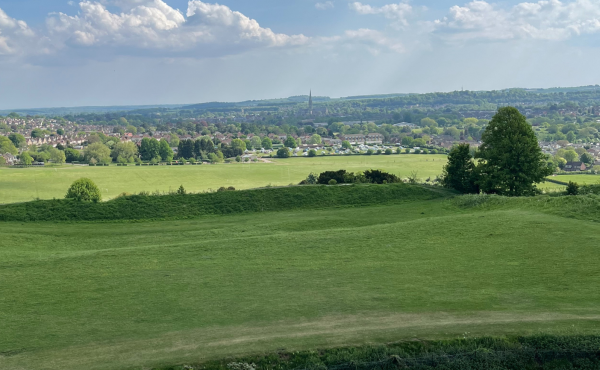
There’s an enormous hill several miles outside of the city center in Salisbury, UK. If you were to climb the tower of Salisbury Cathedral you’d see it in the distance. It’s such a permanent fixture in the landscape that local roads wind around it, and you run into it wherever you try to navigate. The local topography is already hilly in that part of western England, but this is clearly human-made: it ascends with well-plotted symmetry, rise by rise. Scholars suggest the earliest version of this ancient hill-fort was started around 400 BCE as a strategic fortress at such a key crossroad.
By the 11th century CE this impressive mound, known today as Old Sarum, became the site of an imposing Norman castle and the location of the first cathedral. Today, from the remaining walls of the castle enclosure, you can see the cruciform footings of the first cathedral, then the expanded shape of the second cathedral. Monks and bishops lived atop a wind-swept hill in battle-contested times alongside warriors and, from time to time, kings and court officials. The conflict in that uneasy pairing only grew, and the bishop eventually took ox-carts of stones from the original site to build a new market town downriver in land set aside for the church. That ‘new’ town is called Salisbury. Local lore holds that there are more stones from Old Sarum in Salisbury than are left atop the ancient mound, many of which form the massive protective walls the church needed to build in order to protect its cathedral and property.
A few weeks ago, I was back in Salisbury, enjoying time with the Rev. James Woodward, principal of Sarum College. I was enjoying what I called a sabbatical ‘refresher’ (halfway between my previous sabbatical, a large part of time of which was spent in Salisbury, and the next sabbatical, I pray, that’s yet to come). While there, I caught up with with clergy and lay leaders I’ve come to know in that part of the Church of England who are doing remarkably transformative gospel-centered, social-impact work (which is unparalleled in The Episcopal Church). Salisbury and Wiltshire aren’t necessarily tourist hot-spots in England, perhaps which is why I find it so charming. But what do most people, including Britons, say when you talk about Salisbury? The cathedral. “It’s such a beautiful Cathedral,” they say. Indeed, it is.
Hold that thought of Salisbury’s beautiful cathedral.
James told me about an exercise he uses every year before the start of Sarum’s autumn quarter. He takes the theological students, all of whom are doing distance / low-residency learning via Sarum’s ministry program, up Old Sarum. Some walk the entire distance. Others drive. But even if one drives, everyone huffs-and-puffs to the very top of the old castle’s walls. Once there, one is given an amazing view of the Wiltshire plains. It’s one of those vistas a camera simply can’t capture. Try as I might, and I have, my iPhone camera just doesn’t do it justice. It’s something one has to behold in person. And within that stunning panorama there’s a teeny-tiny spire sticking out above the rooflines of the other buildings, just above the trees in the foreground. That spire, of course, is the steeple of Salisbury Cathedral – that beautiful, inspiring, majestic place. Seen from atop Old Sarum, however, it’s just a little speck.
“That’s the perspective one needs in ministry,” James told me, driving home the point of the exercise he uses to set the tone of theological formation at Sarum College for ministry in the Church of England today. Theological students can be so drawn to church, and church-y things, that it’s hard to remember that church is one part of God’s economy. Yes, as Christ’s mystical body, the church is God’s Plan A for salvation (and God doesn’t have a Plan B), but that makes the point even more: church is a gift, a living body, not an institution or thing.
Doesn’t this, then, put a great deal in context? Church unity? Essential. Witness to radical love? So necessary. The church’s need to justify its existence? Hardly. Creatively adapting so we can continue to exist? Nope.
A day or so later, I was taking my own walk to Old Sarum. I wondered if James’ teaching was yet another example of that well-trod analogy used in leadership circles: the person on the dance floor versus the perspective from the balcony. If you’re dancing, that teaching goes, head to the balcony to see the complexities and intricacies on the floor. And vice versa: don’t forget to get in there and dance. But in that analogy one never leaves the hall. The view is from the floor or the balcony, but never outside the event space. But those outside spaces are where life is also happening. What we might tend to think of as ‘negative space’ is where the Kingdom of God is (also) at hand.
What is most remarkable, to me, about the growing communities of Christian faith and practice in the Church of England – and there are many, and what they’re doing is utterly remarkable with hardly any parallels in The Episcopal Church – is that they’ve moved outside the event space, into the ‘negative spaces’ with courage and a fearless love of the gospel of Jesus. They’ve figured out a way to sustain a ‘mixed ecology’ of church life without pointing to the event space.
You can really only get there if you walk way out of the center of the city, and climb a very steep hill, and huff and puff your way to an entirely new vista – which reframes the entire view.
-

Related Post
Five Questions to Guide Your Endowment Planning Susan McDowell, Managing Director, Endowment Management, poses five guiding questions for your endow… -
Related Post
Eleanor Roosevelt and Us Through this story of Eleanor Roosevelt’s formation, we are invited to pay renewed attention to ou… -

Related Tool
Approaching Change in a Congregation Every congregation and community of faith faces the need to change. This lesson workbook wil lintrod…
 RSS Feed

