August 26, 2025
Holy Hospitality
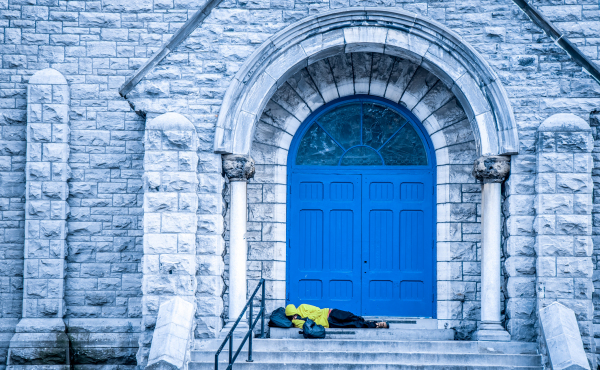
We’ve all heard the narrative: Church attendance and congregational practices have changed and the buildings and spaces of the mid-20th century aren’t as functional as they once were. At the same time, many cities and towns are experiencing an affordable housing crisis and with each passing season, more individuals and families are experiencing homelessness or housing insecurity.
In light of this confluence of circumstances and needs, congregations are reassessing their response to the Gospel in the 21st Century. They are rethinking mission in their communities, considering anew how God might be calling them to share the resources they have, and realizing resources they had not considered before. Notably land and buildings. Through it all, over it all, the Spirit whispers a call to welcome the stranger, share what we have, rekindle the ancient flame of holy hospitality.
Models vary from one community to the next, as responses are influenced by a church’s particular city, town, neighborhood, and history, or by the skills and tolerance of church leadership and church members. The kind of support and collaboration that local nonprofits can provide also makes a difference.
My initial participation in this kind of holy hospitality was with the Pee Wee Homes at the Church of the Advocate in Chapel Hill, North Carolina. There we collaborated with the non-profit Pee Wee Homes to build three small homes, averaging 360 square feet, and provide supportive, permanent housing for individuals with a history of chronic homelessness. In 2024, I received a Louisville grant that has allowed me to visit a wide array of churches providing a wide array of responses to the need. Some churches, like the Episcopal Church of the Resurrection in Alexandria, Virginia, are taking dramatic steps to build high-rise apartments to house dozens, even hundreds, of residents and also provide revenue for the church. Many churches find such projects to be inspiring, and also inconceivable for them. But they are finding ways to be creative and hospitable with the resources that they have. St Peter’s Episcopal Church in Clarksboro, New Jersey, is partnering with Family Promise of Southwest New Jersey to provide temporary housing for a family with housing insecurity in the former rectory. St Andrew’s Episcopal Church in Portland, Oregon is partnering with WeShine Portland to provide microhomes for older adults and people with disabilities, providing not only space for the homes, but also a dog run and a garden, and sharing their kitchen, showers and bathrooms. The First Presbyterian Church in downtown Durham, North Carolina, is making an existing apartment in their parish house available for up to two years for an individual transitioning out of prison. Trinity Memorial Church, collaborating with the Bethesda Project in Center City Philadelphia, provides overnight shelter for up to 22 men, and Lake Washington United Methodist Church in Kirkland, Washington, provides safe parking for women and families in their parking lot.
Each of these projects requires commitment to the call of holy hospitality, patience, and a spirit of collaboration. It is worth noting that churches often start with, and continue, an occasional ministry that yields personal relationships – a weekly food pantry or shared meal, showers in a shower truck once a week, simply offering prayers in the front yard, etc.
As church communities expand hospitality and embrace new ministries, they are discovering reward, discouragement, perseverance, creative problem-solving and faith. They are also discovering avenues of support and collaboration from individuals, nonprofits, municipalities, ecclesial authorities, and God.
It may be that governments working with contractors and large nonprofits can create the most efficient means for providing the most affordable housing and other needs. But it matters that faith communities respond as well, however small we feel our offering may be. As people of God, we are called to respond to our neighbors' needs, and to be engaged in that response. When we open our sites, our doors, our hearts, to others, all are transformed, allowed to know more fully what it means to be human, what it means to be creatures of God, what it means to love as God loves. This is holy hospitality.
The need for supportive care and housing of every kind is expanding. Churches can help. The faithful need to help, for the sake of those who are experiencing economic insecurity or homelessness and out of our own need of God.
Rarely has the confluence between society’s needs and the Church’s calling been so plain.
-

Related Post
Embodying Our Prayers for the Poor The Rev. Lisa G. Fischbeck discusses prayers for the poor in our latest blog post. -

Related Post
Thriving Through Collaboration Episcopal congregations in Indiana continue to find new ways to thrive through the Church Buildings … -

Related Post
The Art of Organizing, Part Two: Building Capacity for Sacred Resistance In The Art of Organizing, written during the early stages of the emerging COVID pandemic, Rev. Dr. G…
 RSS Feed
-

Related Tool
Building Your Asset Map: Building Authentic Relationships -

Related Tool
Approaching Change in a Congregation -

Related Post
A Lenten Checklist