November 25, 2010
Thanksgiving: Giving Thanks to the Giver Good
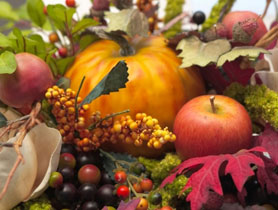 Thanksgiving, or giving thanks, as a form of prayer, is technically the church’s principle act of worship, week after week, Sunday after Sunday, and in many places, like this Monastery, day after day. The Eucharist is itself an extended prayer of thanksgiving.
That’s what the word means, actually, from the Greek, eu, meaning well or good or great and, kharis, meaning favor or gift or grace. Like so many other Greek words that have become part of the Christian lexicon, eucharist had no specifically religious meaning in the first century—it was a completely secular word and simply meant well-favored or good gift or great grace. And so we call that part of the liturgy where we take and bless and break and share bread and wine, the great thanksgiving.
Giving thanks, like all other forms of prayer, is a practice, from the Greek, praxis, meaning something that is done routinely, as in habitually or normatively; or something done repetitively in an effort to improve facility, skill, and familiarity. Both senses pertain here.
My own unscientific observations suggest to me that we get the routine, habitual, normative part of this kind of prayer, especially as we enact it liturgically. Efforts to improve facility, skill, and familiarity—not so much! And I’m not speaking here, of course, about how we conduct the liturgy, per se.
Rather I’m referring to a way of living that sees the gifts of God on every hand and at every turn—a way of being that understands life itself is a gift, and which summons a response of gratitude from the deepest core of our beings. In our Rule of Life we note that we must be vigilant not “to restrict prayer to set times, [rather,] we are to aim at eucharistic living that is responsive at all times and in all places to the divine presence.” Eucharistic living. Life lived as thanksgiving.
The appropriate response to a gift is usually “thank you.” The challenge, it seems to me, to seeing all of life as a gift derives from living at a time in history, when daily life is not primarily about survival, at least for most of the developed world. And that is acutely true here in Cambridge.
Survival—food, shelter, clothing, clean water, safety—is not the primary concern of most of us here this evening. Most of us are living life much higher up Maslow’s hierarchy of needs, with many of us at the very top, grasping for self-actualization as our principal pursuit and preoccupation.
The vast majority of us here this evening know where we will be sleeping tonight, and in all but the most exceptional cases, that place will be comfortable, clean, warm, and dry. Most of us have some idea where our next meal will come from, and if we do not, we can probably choose from a staggering range of options at both restaurants and supermarkets. Winter is coming, and while a few of us may struggle pay the heating bill or buy a warm-enough coat, it’s unlikely that any of us will freeze. No one here worries about stepping on a land mine, or being shot by a sniper, or encountering a suicide bomber at the grocery store or gas station.
Most of us are living where we do and as we do, attending schools and pursuing professions and doing work which we choose to do, as a result of our fortunate access to privilege, power, and education. Most of us in a congregation like this one, are credentialed with a considerable body of personal and professional achievements. And when it comes to the innate gifts which are here present this evening—everything from native intelligence to musical skill to scientific acumen to pastoral sensitivity—there is an embarrassment of wealth and riches.
Is it any wonder that we take so much for granted, that we assume so much as our due and right, rather than gifts, for which the appropriate response is gratitude, expressed by giving thanks to their Giver.
There are many reasons for this unspoken sense of entitlement, but I’ll name two of the most pernicious: First is the myth of the self-made man or women, which has actually become something of an American archetype (and not a good one). It stems from the nation’s new-world-frontier history, and it’s most eloquent proponent was Benjamin Franklin, who promulgated such aphorisms as “God helps those who help themselves” and “Early to bed, early to rise makes a man healthy, wealthy, and wise.”
The former—often thought to be Scripture—is patently not true! Scripture teaches just the opposite: God helps those who cannot help themselves. And the latter is true for only a privileged few. And both underpin the fiction that with enough hard work and industry, by God—oops, not by God—by your own sweat, you can achieve just about anything you want.
In theological terms, this is known as Pelagiansim, a fourth century heresy that teaches that human beings are responsible for their own salvation by the sheer force of their will and reason. The notion is still alive, well, and pervasive in our culture. So much so, in fact, that a former professor of ethics at the Fuqua School of Business at Duke University writes this, in commenting on the national holiday of Thanksgiving:
Thanksgiving celebrates [our] ability to produce. The cornucopia filled with exotic flowers and delicious fruits, the savory turkey with aromatic trimmings, the mouth-watering pies, the colorful decorations—it’s all a testament to the creation of wealth.
Thanksgiving is a uniquely American holiday, because this country was the first to create and to value material abundance. It is America that has been the beacon for anyone wanting to escape from poverty and misery. It is America that generated the unprecedented flood of goods that washed away centuries of privation. It is America, by establishing the precondition of production—political freedom—that was able to unleash the dynamic, productive energy of its citizens…
Many Americans make Thanksgiving into a religious festival. They agree with Lincoln, who, upon declaring Thanksgiving a national holiday in 1863, said that “we have been the recipients of the choicest bounties of heaven.” They ascribe our material abundance to God’s efforts, not [our own]…
That view is a slap in the face of any person who has worked an honest day in his [or her] life. The appropriate values for this holiday are not faith and charity, but thought and production. The proper thanks for one’s wealth goes not to some mystical deity but to oneself…
There is a spiritual need fed by the elaborate meal, fine china and crystal, and the presence of cherished guests. It is the self-esteem that a productive person feels at the realization that [their] thinking and energy have made consumption possible.**
And if you don’t think he’s on to something here, just watch how much news is devoted to retail sales indicators during the week leading up to and even more on the day after Thanksgiving, which is the commencement of the so-called “Christmas shopping season.” We will see very few reports of record church attendance or of selfless acts of altruism. As a nation we’ve come a long way from King David’s words: All things come of thee, O LORD, and of thine own have we given thee (1 Chronicles 29:14b). If you’re self-made, no one has given you anything. You’ve earned it.
The second reason for our difficulties with thanksgiving as prayer is closely related to the first, and it is our history of independence—historically as a nation, in practice as a culture, and endemic among self-made men and women, who, after all, are not dependant types.
To acknowledge that what we have in this life is a gift is to admit our dependence on a giver, and some of us, perhaps even most of us, do not like the notion of being dependent. I know I do not. It flies in the face of my carefully tended illusion of self-sufficiency.
I know a man (not from here) who takes considerable pride in his considerable intellectual prowess and academic achievements—and who also finds it excruciatingly difficult to acknowledge that those things were possible because of the gift—completely unearned—of a brilliant mind, unlike any known in living memory in his very humble family of origin. And so he lives in the very small, lonely, self-sufficient, rarified world of his own mind.
There is a solution for this, for his, for mine, for yours: it is thanksgiving. This is the grace that comes from gratitude expressed: giving thanks always takes us beyond ourselves to the giver, and when that Giver is God, thanksgiving, like praise, puts us in right relationship to God, as creatures to our Creator.
Benedictine David Steindl-Rast observes:
The receiver of a gift depends on the giver. Obviously so. But the circle of [gratitude]*** is incomplete until the giver of the gift becomes the receiver: a receiver of thanks. When we give thanks, we give something greater than the gift we received, whatever it was. The greatest gift one can give is thanksgiving. In giving gifts, we give what we can spare, but in giving thanks, we give ourselves. One who says ‘Thank you’ to another really says, ‘We belong together.’ Giver and receiver belong together. The bond that unites them frees them from alienation.****
The prayer of thanksgiving, like the prayer of praise, frees us from the bondage of our own too-small worlds. It lifts us beyond ourselves and our petty preoccupations. And it does not come naturally to any of us. Rather, paradoxically, like all prayer, thanksgiving is a gift, from God, for us, waiting to be received.
Thanks be to God.
*The title derives from the last phrase of the first stanza of Robert Seymour Bridges’ translation of a hymn by Paul Gerhardt (1607-1076); found in The Hymnal 1982, #46, it is a favorite hymn at Compline at the Monastery.
**Gary Hull, “Thanksgiving: An American Celebration of the Creation of Wealth,” Capitalism Magazine, Ayn Rand Institute, November 21, 2006, accessed online at http://www.capmag.com/article.asp?ID=3279 on October 1, 2009.
*** The actual word the author, David Steindl-Rast, OSB, uses is gratefulness, a nuanced concept he develops at length in his book; Gratefulness, the Heart of Prayer: An Approach to Life in Fullness. I substitute gratitude here in the interest of clarity and brevity, with, I believe, no violation of his intention or meaning.
****David Steindl-Rast, OSB, Gratefulness, the Heart of Prayer: An Approach to Life in Fullness (Ramsey, NJ: Paulist Press, 1984), p.17.
-

Related Tool
Building Your Asset Map: Building Authentic Relationships Congregations often forget that their most important mission field is int heir own backyard. This le… -

Related Post
Embodying Our Prayers for the Poor The Rev. Lisa G. Fischbeck discusses prayers for the poor in our latest blog post. -

Related Post
Failing Upwards When something doesn’t work out, what do you do? And how long does it take to try something else?…
 RSS Feed
-

Related Post
Understanding the Unfolding of Your Calling: A Conversation with Sister Hannah -

Related Post
Walking Through Fear to Joy -

Related Post
Eleanor Roosevelt and Us