May 13, 2025
“Aux Arc Maquis”: Where Outreach is Resistance

In Fall 2024, small and rural Episcopal congregations in the Episcopal Diocese of Arkansas were offered the opportunity to participate in Pivot, a hybrid program offered by ECF to have us reflect on our faith community identities, learn about our neighborhood composition, and develop a mission that meets the needs of our respective contexts. This gave St. Andrew’s Church in Mountain Home, Arkansas, the chance to learn something new about how to develop a more outward-facing posture. Through an online curriculum, in-person gatherings, and Zoom sessions, we were encouraged to draft new Gospel-rooted, neighbor-focused mission and vision statements. This was all very exciting to us, and as a parish going on four years without a paid priest, we had come to realize that we laity are, in fact, the church.
Our congregation’s Pivot work came at a perfect time to coincide with the work of St. Andrew’s Education for Ministry (EfM) group which started in January 2025. EfM is a four-year, small-group formation program based on study and practice in theological reflection. At its core is the idea that all baptized Christians are ministers. God calls us to be active participants in ministry. This group turned out to be a stable of racehorses, ready to rethink mission, learn, and apply. Our group is almost entirely composed of ex-Evangelicals from the area, and this has shaped our discussions. After learning of each member’s spiritual background (and trauma), it became clear to our group that our mission was to resist the version of Christianity represented by many white Evangelical Christians, particularly in our profoundly conservative region in the Ozarks.
This region is white (nearly 95%) and Evangelical (comprised mostly of Baptist, Church of Christ, and Assemblies of God congregants). White Evangelical pastors and preachers here and across the country twist Biblical passages to guide their congregations politically, parroting conservative pundits and gaining social and political control. Meanwhile, the most vulnerable in our society – the poor, the LGBTQ+ community, our migrant neighbors – face material danger from state and federal decision-making. What could our little Episcopal Church EfM group do?
Our EfM group (joined by the mighty Daughters of the King firebrands) took a very tangible first step. One EfM seminar member applied for permission to protest and on March 29, we gathered on the steps of the Arkansas Capitol building in Little Rock to stand as a visible witness against the illegal firing of federal workers, the damage to science and health and the impact that will have on poor and rural Arkansans, gun violence, and of course, Christian Nationalism.
This rally spurred further discussion about how we could reasonably expect to influence the politicized Evangelical population here. As part of Pivot, our congregation discussed establishing several prongs of resistance we can employ to amplify Jesus’ actual teachings and words. The aim is to hold Christian truth up to Christian Nationalists’ agenda of political control in our cities, counties, and state. We will establish a justice committee that tracks local and state issues that Christian Nationalists aim to control: access to libraries; PBS and NPR content and funding (free, educational television and objective news); environmental care that resists the pollution and degradation of our beautiful mountains, rivers and lakes; and LGBTQ+ protection in schools and public spaces. We also want to raise awareness that unlawfully arresting and deporting immigrants without due process is not what Jesus would have us do.
On our website and Facebook pages, we are preparing to amplify an Episcopal alternative to our Evangelical neighbors, some of whom we know struggle to reconcile their Christian faith with increasingly anti-Gospel viewpoints. Our Episcopal culture is an alien denomination in the Ozarks, and we are the smallest denomination of all. Since there is a serious knowledge gap about us, we will offer a wide variety of information using links, articles, and podcasts about our history, culture, practices, books, movies, and other sources that describe the Anglican Way:
- We are starting with simple steps like ensuring that we project the service online.
- We have started the role of online verger (something we learned in the Pivot project), who can reach out to any online visitors to break down cultural barriers and explain the liturgical motions and why we do them. This is increasing online engagement from around the region to 40-50 weekly.
- We have notable local musicians who play music in the Ozark vernacular (one is in our EfM seminar), so when curious Evangelicals or ex-Evangelicals attend our online service or come to attend in person, they will hear at least some music that is familiar to them.
- Our discussion podcast will be titled “Aux Arcs Maquis” (translates to “Ozark Scrubland Resistance”) using the native French and Indian terminology for the mountains (Aux Arc) and as a term for the French Resistance (Maquis). We will host discussions on local and national issues where politics and religion intersect and offer our reflections on the meanings of Jesus' words and teachings. We will publish on multiple platforms: Substack, Facebook, Instagram, YouTube, and even TikTok.
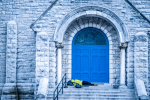
- And, if a wayward Evangelical makes it through our red doors, we will offer free Episcopal literature in our narthex for anyone to pick up and online during live services.
Our country needs to hear that there is an alternative Christianity to that of Christian Nationalism. Our little Episcopal congregation believes that through radical welcome, online engagement, and public witness, we can amplify Jesus’ teachings and live out our baptismal covenant: resisting evil, proclaiming the Good News, loving all people, and striving for justice and the dignity of all.
Kim Wood is a member of St Andrew’s Episcopal Church in Mountain Home, Arkansas. St. Andrew’s is located smack in the middle of the Ozarks. They are 1% of the population in a regional culture of conservative Evangelicalism, offering a progressive and liturgical alternative community of Christian practice to all those who seek it.
-

Related Post
The Art of Organizing, Part Two: Building Capacity for Sacred Resistance In The Art of Organizing, written during the early stages of the emerging COVID pandemic, Rev. Dr. G… -
Related Post
Holy Hospitality The need for supportive care and housing of every kind is expanding. Churches can help. The faithful… -

Related Tool
Faith-Based Community Organizing: Book Study Groups This list includes resources to help your small group engage in meaningful conversations about congr…
 RSS Feed
-

Related Tool
Building Your Asset Map: Building Authentic Relationships -

Related Post
A Lenten Checklist -

Related Post
Thriving Through Collaboration