June 5, 2025
What Ruby Taught Me
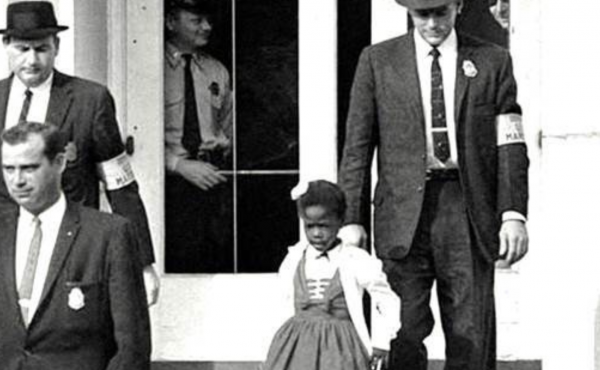
I can’t remember when I first learned of Ruby Bridges’ story. Maybe in U.S. history class in high school, circa 1981? Maybe when I was studying Constitutional law in college in 1986? Or maybe not until I was working at a preschool in 2014. Whenever it was, the story seemed like a long time ago (even in 1981!). I never imagined that Ruby Bridges was/is still alive. And I never dreamed that I would hear the story of 6-year-old Ruby from the mouth of 71-year-old Ruby. Vibrant, sassy, funny, faithful 71-year-old Ruby.
I began working with kids at my church in 2014. I began talking with kids about social justice at a Peace Camp for kids in 2017. In the fall of 2020, I began to think about talking to kids about racism through the lens of our Christian faith. I connected with Will Bouvel, who also worked with kids at church in a secular class. We connected over our commitment to faith and our ministry in the Episcopal church. We collaborated closely because Covid allowed us the time and space we would never otherwise have.
In Lent of 2021, Will and I told six stories to 31 kids in our two parishes over Zoom. The stories covered 500 years of history in language that a 4-year-old could understand, that “… racism tells us a lie about who we are. And we know it’s a lie because of the Truth we know from our faith, that we are all equally beloved children of God…” One of the six stories includes Ruby Bridges’ story, highlighting especially how important was her white teacher, Mrs. Barbara Henry. How Ruby prayed every day before she went to school, how she prayed for the people shouting awful things at a 6-year-old walking into school.
Now it’s 2025. Will and I have been telling these stories for five years. We received a Becoming Beloved Community Grant which enabled us to train 18 cohorts of storytellers across the U.S. and Canada via Zoom. I received an ECF Fellowship that has enabled me to continue sharing the Good News that antiracism offers. Along the way, Will and I learned that our stories are most often told in intergenerational spaces. We’ve learned that storytelling is basic to our humanity and to our faith, and by telling a story, you reach a person’s heart. We’ve learned that while academic style training is important, we offer a new paradigm for antiracism work, something more basic to the human experience and which is based on the Good News of Jesus.
Will and I are confident in our message and yet wonder about the perceived audacity of two white people boldly proclaiming the Gospel and talking about racism. We do this work in relationship with people of color who assure us that “this is white people’s work to do” and encourage, even implore, us to keep going. What I learned when Ruby Bridges shared her story is that it’s more than “white people’s work” to dismantle racism. White faces and white hearts showing up sends a powerful message to our siblings with more melanin and to other white people as an example of what it looks like to change the narrative.
White people have been culturally indoctrinated to believe that Black people should be taking the lead in conversations about race and train us how to “solve” this problem in our world. In a way, this absolves white people from doing anything more than academic, book-based learning. This narrative puts the responsibility on the oppressed people to “teach us.” It absolves white people from taking any action that is not directed by Black and Brown people. Because, WHAT IF WE, THE WHITE PEOPLE, ARE NOT PERFECT?
What I learned from 6-year-old Ruby Bridges is that simply the face of a white person with love in their heart matters. The face of Ruby’s first grade teacher, Mrs. Barbara Henry, “looked exactly like those people outside who were yelling mean things, but she had love in her heart.” It matters to Black and Brown people, and it changes the narrative that white people must sit by and wait for Black and Brown people to tell us what to do.
My Christian faith tells me that I don’t have to be a part of an oppressed group to be called into – and to call others into – seeing the full humanity of oppressed people. Jesus was not a leper, or a widow, or a prisoner. And yet he calls us into the Good News that we are all equally beloved children of God, all of us. If I can receive and live into that love for me, then and only then can I share it with others.
Ruby Bridges helped me see that showing up matters. Faces of any color can represent a heart filled with love – or hate. My faith helped me hear the Good News that there are no hierarchies in God’s love.
-

Related Post
The Art of Organizing, Part Two: Building Capacity for Sacred Resistance In The Art of Organizing, written during the early stages of the emerging COVID pandemic, Rev. Dr. G… -

Related Post
Holy Hospitality The need for supportive care and housing of every kind is expanding. Churches can help. The faithful… -

Related Tool
Freedom for Immigrants Freedom for Immigrants is an immigrant-led, abolitionist organization committed to ending immigratio…
 RSS Feed
-

Related Tool
Building Your Asset Map: Building Authentic Relationships -

Related Post
A Lenten Checklist -

Related Post
Thriving Through Collaboration