
I don’t know all of the particulars about who and how the lessons of the lectionary were chosen, but it seems to me they must have been thinking about Annual Meetings when they chose the ones for Sunday, January 29, this year.
From Micah: “O mortal, what is good; and what does the LORD require of you but to do justice, and to love kindness, and to walk humbly with your God?”
From Psalm 15: “Whoever leads a blameless life and does what is right, who speaks the truth from his heart. There is no guile upon his tongue; he does no evil to his friend;”
Continue reading...

Parishioners and visitors staying in touch with our church community and each other is a critical component of a welcoming and vibrant ministry. In the past and also very much today the primary means of communication within our church is by word-of-mouth. Through a chance meeting at a grocery store or social event, a telephone call to a parishioner, or a planned visit, those absent for a Sunday or months of Sundays are given an update on the church happenings in these interactions. While these means of communication are great and necessary they can sometimes lead to inconsistent or wrong information being conveyed. Sometimes the messenger does undermine the message especially if an unhappy or gossip-filled parishioner.

What are you doing on Friday during the inauguration?
More importantly, what will your church do?
Many of us have probably read about the debates within the Episcopal Church: Should we pray for the president-elect by name? Should Washington National Cathedral host the inaugural prayer service? Should the cathedral choir sing?
People of deep faith and strongly held convictions have expressed a variety of answers to these questions. I am not going to offer my opinion here. It isn’t the place.
Instead, I’ll repeat the question: On Inauguration Day, what will your church do?
Continue reading...

Are you a vestry member or other church leader interested in practical, spiritually grounded resources for your congregation?
Subscribe for free to ECF Vital Practices for articles, tools, and resources by and for congregational leaders. With a subscription, you’ll receive 12 issues of Vestry Papers as well as the monthly digest delivered to your inbox.
This post introduces you to our digest for January, featuring 5 ways to help your newly forming vestry get off to a strong start.
Continue reading...

Teams that work well together understand that each member must respect the others’ opinions and priorities. Together, they find and honor what they value in common.
As you plan the first meeting with a “new” vestry, consider this exercise that helps identify shared values. It also serves as an ice-breaker that goes much deeper than, “Please state your name, how long you’ve been attending St. Swithens, and your favorite liturgical color.”
Continue reading...

On Christmas morning a few weeks ago, we turned from the infant in the cradle to give our worship to the mighty God who came among us as that baby. We read these words: “In the beginning was the Word, and the Word was with God, and the Word was God.”
The Word: this is one of our most holy names for Christ, the second person of the Trinity, the Beloved Child of God. Christ is the Word of God. And, as John tells us, Christ the Word was present with God in the act of creation—all things came into being through the Word, just as it is written in the book of Genesis. God speaks, and worlds are created.
Words create worlds.
Continue reading...

For years, I hosted a Rose Tea for the women of the church on the weekend of the third Sunday in Advent (Rose Sunday, hence the name). It was always a lovely occasion with great conversation, delicious food, and sometimes a few carols. But after everyone left the house, I flopped onto the couch, a cartoon effigy of a woman sapped of every morsel of energy.
Who throws an extra party into the pre-Christmas mix? What kind of glutton for punishment am I? Over the years, we’ve gotten much wiser (at least on this account). We host gatherings for the church and staff during the actual Christmas season – or in the first few days of Epiphany. This year, the church staff enjoyed a Christmas luncheon on the day of Epiphany. Vestry members (as well as spouses/partners or family) came to our house for dinner on the first Sunday of Epiphany, and last night, the staff of my workplace (a faith-based organization) held its holiday gathering.
Continue reading...

“The first significant wave of multisite churches started coming onto the North American church scene roughly two decades ago,” writes Warren Bird, director of research for the Leadership Network, capturing the history of this recent movement. “In the 1980s there were well under 100 and in the 1990s at most 200. During the 2000s growth increased at a rapid pace with the greatest number of multisites being birthed within the last ten years.” (Leadership Network / Generis Multisite Church Scorecard, 2014, p.5; download here.)
A multisite church is defined as one church that meets in multiple locations. This recent category in North American Christianity is the result of megachurches who, for various reasons, struggled with the question about whether to build an even bigger building or plant additional satellite campuses. The shift from mega-turning-mega is, I suspect, also a smart response to the larger demographic and cultural turn away from ‘big box’ anything and toward more boutique and locally-owned, locally-sourced products, Christianity included.
Continue reading...

Pope Francis stated in his Christmas message of 2014, "
Preparing things well is necessary, but don't fall into the temptation of trying to close or direct the freedom of the Holy Spirit, which is bigger and more generous than any human plan."
As we begin the New Year 2017, many leaders are planning in earnest the work that needs to be accomplished for the year. For the procrastinators among us now is a good time to start. Within congregations, a Parish Coordinator is essential to ensure that all items planned by the clergy, vestry, and committees are reflected on a master calendar.
Continue reading...
Coming to church saves lives.
Literally.
At least it did in our congregation on Christmas Eve.
If you read only one blog, read this. If you’re going to follow the advice of only one best-practices column, let it be this one.
It’s a lifesaver.
Continue reading...

Management guru Peter Drucker wrote often about “planned abandonment.” This is the idea that we need to intentionally put to death and bury the activities and thinking that are hindering us from spending time on more fruitful activities. We must put to death the old to make room for the new.
I spend time each year between Christmas and New Year’s Day reflecting on the past year and looking ahead to the next. In my previous career, it was looking at my previous billable hours and workplace accomplishments, and setting goals for the coming year. But it was/is also a time to celebrate what God has been doing in my life and work and ministry, and considering where God seems to be leading me into the future.
Continue reading...

New year, new vestry, same old issues. If that sounds familiar, consider your 2017 time together as opportunity to create a holy balance of prayer, formation, vision-level strategic thinking and routine business. It’s so easy to let the rush of life and issues of the day rule vestry agendas. Making a commitment to keep spiritual growth a part of your time together will prove more beneficial than just meeting the basic needs of “the business of the church.” Here are some ideas for creatively planning your meeting year:
February is an Ideal time for a Vestry retreat, particularly to incorporate new members into the leadership team. If you can swing it, take a road trip to the 2017 Church Leadership Conference at Kanuga Conference and Retreat Center in western North Carolina, February 17-19, 2017. Click here for more information and registration.
Continue reading...

Episcopalians love processions. There’s something about the grandeur, of course, especially if such a procession includes all kinds of liturgical accoutrements, but even in a more humble parish church, such as the one in which I serve, a liturgical procession is a profound opportunity to create a more intentional setting of space and place. (There’s also the joke in which the Baptist preacher, the Catholic priest, and the Anglican vicar are talking about how much time they spend writing sermons. Baptist: all week; Catholic: reading Encyclicals from the Holy Father; Episcopalian: “What?! You all don’t have an opening procession?)
Continue reading...
Topics:

My church didn’t have the usual children’s Christmas pageant this year, but we certainly did rejoice in evidence of God with us. The third Sunday of Advent included 5 Baptisms and 11 Confirmations, Receptions, or Reaffirmations! It was a bittersweet day, however, for while our new Bishop came to help us celebrate, we also bid a formal farewell to our Rector who is retiring after ten years of faithful, fruitful ministry. Whew! There was a lot going on.
Continue reading...

This month we offer five resources to help your congregation get ready for Christmas. Please share this digest with others in your congregation and invite them to subscribe to ECF Vital Practices to receive Vestry Papers and this Vital Practices Digest in your inbox each month.
Continue reading...
For two days in February 2014, workers on the London Underground went on strike, closing several subway stations and forcing an even larger number of commuters to scramble to find a new route to work. In a study published earlier this year, researchers pulled data from transit cards of commuters before, during, and after the strike. Using this information, they charted how many commuters had to change their routes to work around the station closures.
By necessity, many commuters had to alter their routes during the strike. Since we tend to be creatures of habit, one could reasonably assume that folks would go immediately back to their original route as soon as the strike was over. But that wasn’t the case.
Continue reading...

As we prepare for the festive season of Christmas and New Year with family and friends, we are also reminded that for many these are days of great despair. Whether through illness, being shut-in, loneliness, loss of loved one, or estranged family members, this “hallmark card” season exacerbates many underlying issues.
It has been proven numerous times that contact with a compassionate and caring person in many cases can be the antidote to this despair. As church members and leaders, caring for others, especially those in our church community, should be our number one priority and the space where we excel above all institutions because we have the example and teachings of Jesus as our guideline.
Continue reading...

Among my character traits, you will not find “waits with patience.”
Whether it’s for a table at a restaurant, on hold with customer service, or anticipating a big trip, waiting is not among my virtues.
That makes Advent really hard.
Continue reading...

In my corporate work, I used to facilitate a workshop called the M.A.G.I.C. of Customer Relations, which emphasized communications and relationships as two of the keys to delivering exceptional customer service. Early in the program we pondered a quote by Virginia Satir, the American social worker and author who is widely regarded as the pioneer of family therapy. According to Ms. Satir: “Once a human being has arrived on this earth, communication is the largest single factor determining what kinds of relationships he makes with others and what happens to him in the world about him.”
Continue reading...
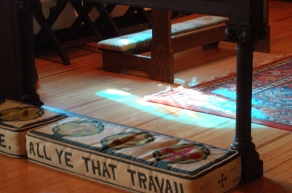
This is a busy time of year both inside and outside the church. Someone said to me last week, “You must be so terribly busy,” and she was very kindly implying that there’s probably a great deal of work behind organizing our congregation’s annual meeting a few days’ ago and getting ready for the Christmas pageant and worship preparation for this season and Christmas Eve and pulling off last Sunday’s Advent Lessons & Carols. I admitted to her that, yes, it’s a full time for all of us, both church-workers and everyone else. But in the back of my mind I wasn’t really thinking about all the work. In fact, in the back of my mind was that series of emails and meetings, way back in late-September, with the president of the altar guild, during which we reminded one another of the times of services and the little details attached to all the special observances which were coming up from late fall through early January.
And with that series of emails and, I think, two phone conversations, the work has indeed been out of my hands, and into the hands of vastly more capable people -- namely, that blessed institution called the Altar Guild.
Continue reading...
 RSS Feed